Checklist for writing (Dysgraphia)
- Avoids or shows reluctance toward writing tasks.
- Finds difficult in copying from board or book.
- Struggles in basic writing patterns - lines,curves,circle,etc.
- Shows delays in developing basic handwriting.
- Struggles to recall the correct shapes of letters and numbers.
- Frequently reverses or inverts letters, numerals, or symbols while writing.
- Irregular spacing while writing letters or words and numbers.
- Has difficulty maintaining proper alignment on the writing lines.
- Lack of understanding in direction, writing from left to right.
- Feels fatigue or pain in wrist / elbow while writing.
- Struggle in holding or grip of writing tool.
- Shows difficulty in maintaining appropriate body posture.
- Displays improper positioning of paper, writing tool or hand during writing task.
- Produces untidy or incomplete written work, often with multiple corrections.
- Copies text inaccurately, often mixing up similar-looking letters and numbers.
- Demonstrates inconsistent and weak spelling, sometimes writing the same word differently in one piece of work.
- Finds difficult in comprehension - to summarize, create outlines or structure written assignment.
- Struggles to generate ideas, leading to incomplete writing task.
- Presents written thoughts in an unorganized or unclear manner.
Check list for Parents and teachers
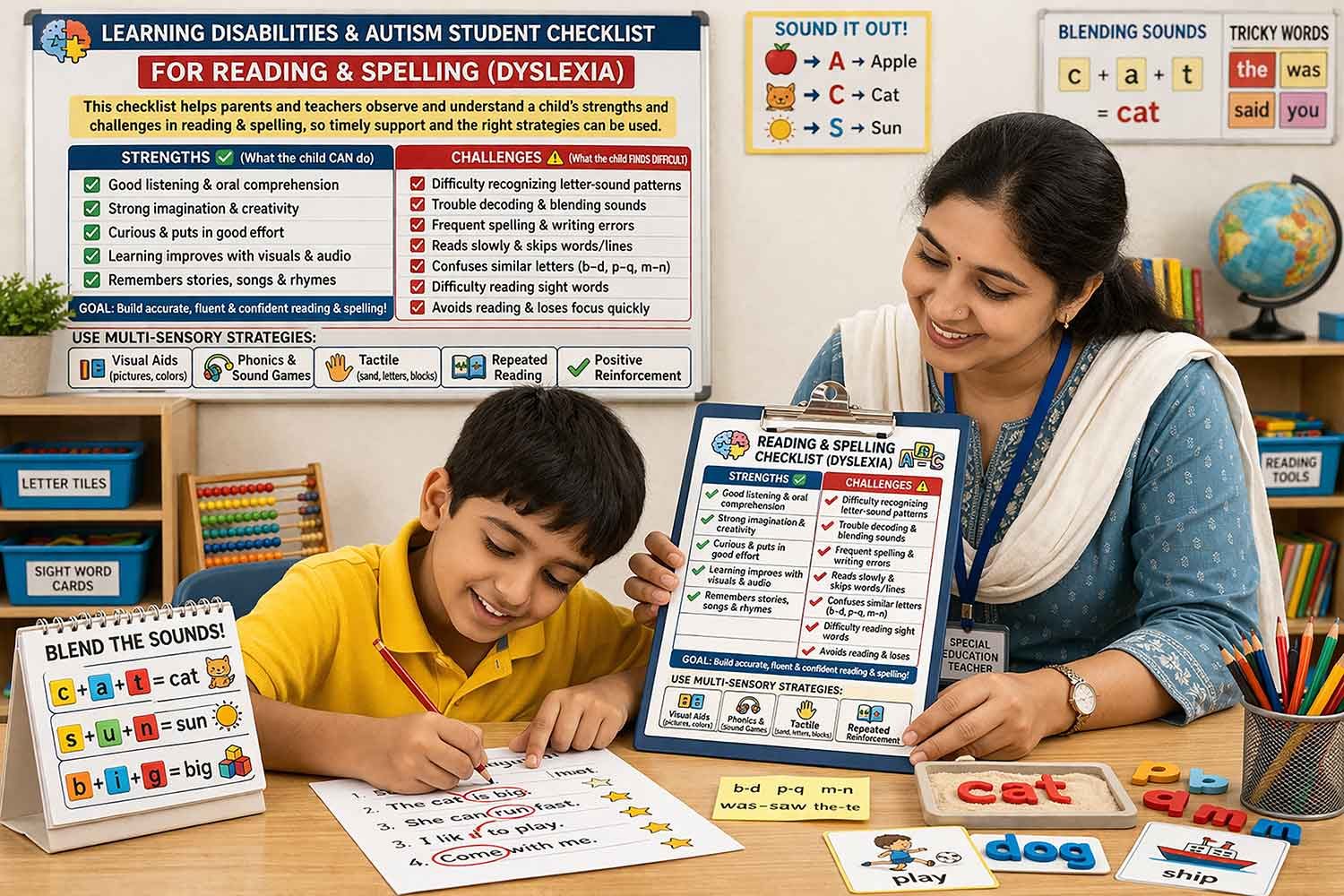
This checklist helps parents and teachers observe and understand a child’s learning strengths and communication challenges, so that timely support and appropriate strategies can be provided.
At YASHA academy, we assist with screening, early identification, and implementation of structured teaching, behavioral and communication strategies for children with learning challenges, attention and developmental delay in speech and language.
Disclaimer
- This checklist serve as observation screening tools to identify potential signs of Learning Disability/difficulty/slow learners and Attention Deficit
- A formal clinical/psychological assessment is required for diagnosis
- Early identification + structured remedial intervention = better outcomes.